
September 7, 2026
Burning After Sex but All My Tests Were Normal
Normal test results don't mean nothing is wrong. They mean you don't have an infection.
Burning after sex is more often caused by things a swab can't detect: thinning tissue from low estrogen, a pain condition at the vaginal opening, a skin condition, pelvic floor muscles that won't release, or a reaction to a lubricant or condom. Each has a different fix, and none of them shows up on an infection panel.
The problem is that the standard workup stops at infection. When it comes back clean, a lot of women get told everything looks fine and sent home. Here's what to look at next.
What a negative swab actually ruled out
A typical panel covers yeast, bacterial vaginosis, trichomonas, and often chlamydia and gonorrhea. That's it. It says nothing about your hormone status, your skin, your nerves, your muscles, or what you're putting on your vulva.
So the negative result is useful. It just isn't an answer.
The five causes worth working through
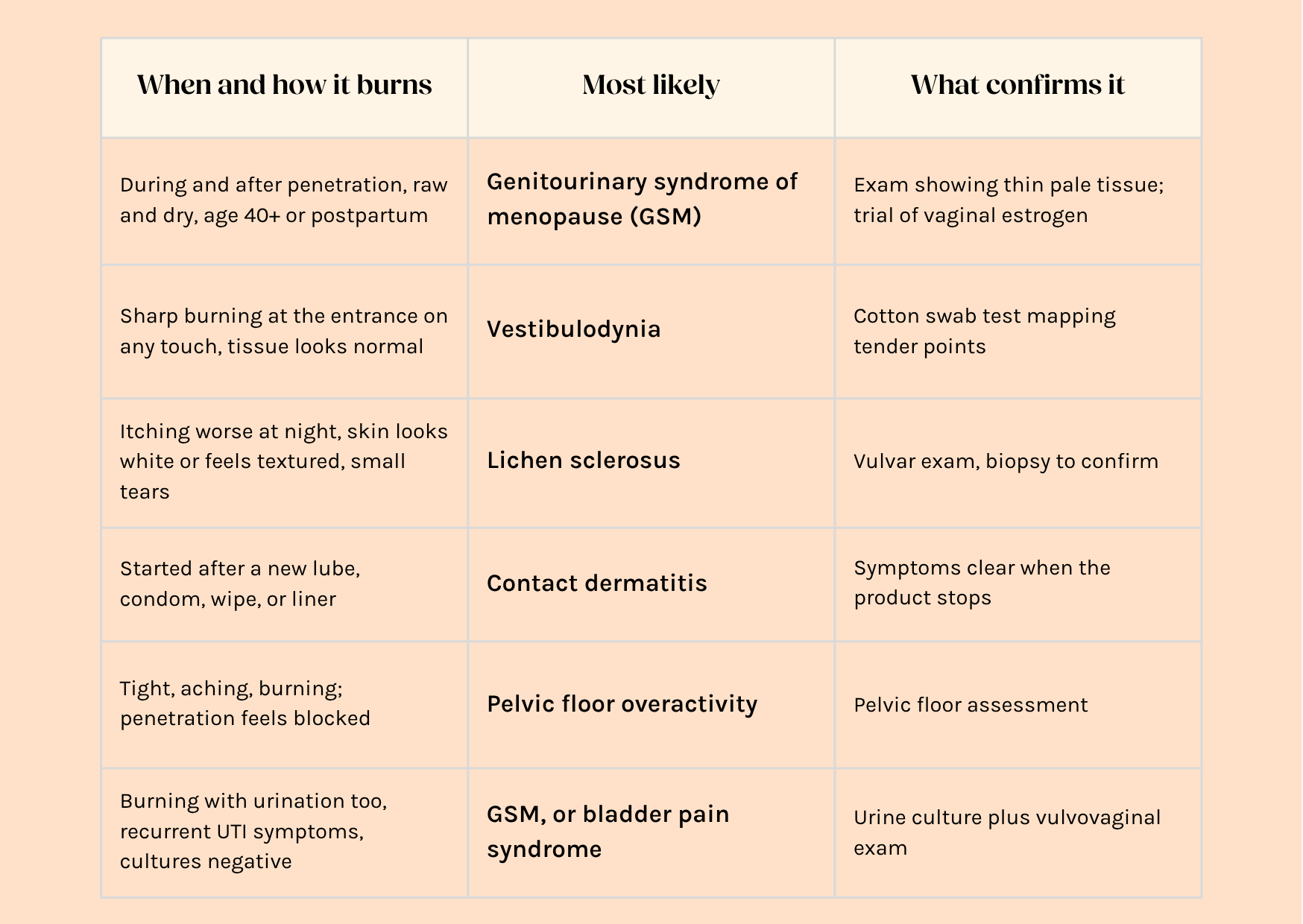
Low estrogen in the vaginal tissue. The vulvar and vaginal tissue depends on estrogen to stay thick, elastic, and lubricated. When estrogen drops, that tissue thins and the friction of sex creates microscopic tears you feel as burning for hours or days afterward. This is commonly called genitourinary syndrome of menopause or vaginal atrophy, and it doesn't wait for your last period. Perimenopause causes it. So does breastfeeding, and so do some hormonal contraceptives.
The tell is timing and quality: burning that starts during or right after sex, described as raw or stinging rather than itchy, often with a sense of dryness that lube helps only partly. Vaginal estrogen usually settles it, and it's a local treatment with minimal systemic absorption.
Vestibulodynia. Pain localized to the vestibule, the ring of tissue at the entrance to the vagina. It's often described as burning, sometimes as cutting or like broken glass, and it's provoked by touch: penetration, a tampon, a speculum, sometimes tight jeans. The tissue frequently looks normal, which is exactly why it gets dismissed.
There's a specific exam for it, the cotton swab test, where the clinician touches defined points around the vestibule and maps which ones are tender. It takes about a minute and it's diagnostic. Almost nobody is offered it.
One subtype is worth naming separately: hormonally mediated vestibulodynia, associated with combined hormonal contraceptives but we have seen it also with progesterone IUDs or the implant, which lower free testosterone and can thin vestibular tissue. The evidence here is observational and not settled, and plenty of women take the pill with no vulvar symptoms at all. But if your burning started within months of beginning a pill and never fully went away, it belongs on the list of things to discuss.
A skin condition. Lichen sclerosus and lichen planus both cause burning and both are routinely missed for years, partly because they get treated as thrush. Lichen sclerosus classically causes itching worse at night, whitened or crinkly-textured skin, and small splits that open with sex. Untreated, it can cause architectural change, so this is one you want identified rather than lived with.
Contact dermatitis is the more common and more fixable version. Lubricants with glycerin or propylene glycol, warming or flavored lubes, spermicide, latex, scented liners, and wipes all cause it. Osmolality matters: several popular lubricants are hyperosmolar and pull water out of vaginal cells, which produces burning in some women and increases irritation.
Pelvic floor muscle overactivity. Muscles that hold in a shortened, guarded state produce burning, aching, and a sense of tightness, and they can make penetration feel like hitting a wall. This often develops secondary to something else. You had an infection or a fissure, your body braced against pain, and the bracing outlasted the original problem. Pelvic floor physical therapy is the treatment, and it works.
Something in the mechanics. Not enough arousal time, not enough lubrication, a position that puts pressure somewhere it hurts. Worth saying plainly because it's real, it's common, and it's usually the first thing women blame themselves for. It's also rarely the whole story when the burning lasts for hours afterward.
Sorting it out by pattern
Subscribe to our free newsletter, The Clit Club, to receive our best tips on menopause, perimenopause and women's health — straight to your inbox:
What to ask for
- Ask for a cotton swab test of the vestibule.
- Ask for a vulvar skin exam with good lighting (which we do by video or text all the time!) separate from the speculum exam.
- Ask about vaginal estrogen, or DHEA, if you're perimenopausal or older, breastfeeding, or on a hormonal contraceptive.
- Ask for a referral to pelvic floor physical therapy.
And don't forget to bring the actual bottle of lubricant you use!
What to change while you're waiting for answers
Switch to a plain lubricant without glycerin, propylene glycol, flavoring, or warming agents. Silicone-based lubricants suit a lot of women with irritated tissue. Stop wipes and scented liners entirely. Wash with water only. If you're using a topical antifungal you were never confirmed to need, stop that too, because it may be part of the problem.
None of that is a treatment. It removes variables so the picture is clearer when you're finally examined properly.
Common questions
Can you have burning after sex with no infection at all?
Yes, and it's the more common scenario once infection has been ruled out. Hormonal, dermatologic, neuropathic, and musculoskeletal causes all produce post-coital burning with entirely normal swabs.
Why does burning start hours after sex rather than during?
Delayed onset points toward microtrauma in thin tissue or a contact reaction rather than an infection. Both take time to become symptomatic and both can persist for a day or more.
Could this be an allergy to semen?
Rarely, yes. Seminal plasma hypersensitivity exists and typically causes burning, swelling, and redness within minutes of exposure, with symptoms absent when a condom is used. That pattern is worth reporting.
Can birth control cause vaginal burning?
It's plausible and it's debated. Combined hormonal contraceptives lower free testosterone and can affect vestibular tissue, and there's a described subtype of vestibulodynia linked to them. The evidence is observational rather than definitive. If the timing fits your history, raise it.
Is it in my head?
No. Pain conditions of the vulva are physical conditions with physical findings, most of which require a specific exam nobody performed. A normal infection panel isn't evidence of a psychological cause, it's evidence that the wrong question was asked.

Want to Talk Through What You're Experiencing?
Book a free 15-minute intro call with Gliss Wellness — no referral, no waiting room, just a real conversation with an OB/GYN. Click here to get started.
Sources
- CDC, STI Treatment Guidelines: Diseases Characterized by Vulvovaginal Itching, Burning, Irritation, Odor, or Discharge. https://www.cdc.gov/std/treatment-guidelines/vaginal-discharge.htm
- "Vulval lichen sclerosus in primary care: thinking beyond thrush and genitourinary symptoms of the menopause," British Journal of General Practice. https://bjgp.org/content/73/730/234
- Burrows LJ, Goldstein AT, "The Treatment of Vestibulodynia with Topical Estradiol and Testosterone," Sexual Medicine, 2013. https://academic.oup.com/smoa/article/1/1/30/6955902
- "Can oral contraceptives cause vestibulodynia?" PubMed. https://pubmed.ncbi.nlm.nih.gov/20102483/
- "Hormonal contraception and vulvodynia: an update," GREM Journal. https://gremjournal.com/journal/03-2021/hormonal-contraception-and-vulvodynia-an-update/
- "Lichen sclerosus: The 2023 update," Frontiers in Medicine. https://www.frontiersin.org/journals/medicine/articles/10.3389/fmed.2023.1106318/full



Real Talk, No Filter
Join our newsletter, where we talk about perimenopause, hormones, sexual health, and everything else!